

Quick summary
- What is Vibe Design? The Death of Technical Specification
- From Sketch to Functional Prototype: The End of "Handoff"
- The Abstract Differentiator: Where "Vibe" Becomes Production Code
- Market Positioning: The Future in 6 Months
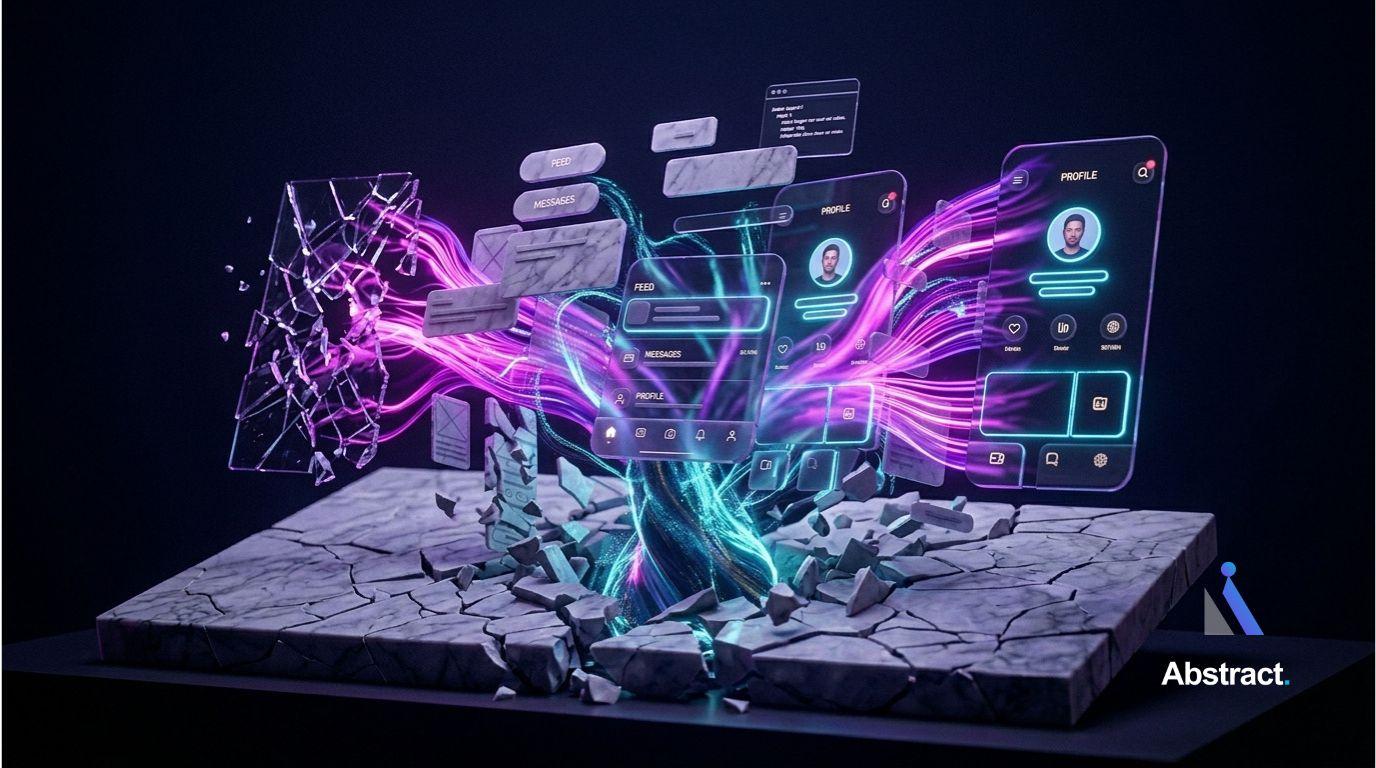
Interface design as we know it — a slow process of drawing static screens and then "hoping" the developer replicates them — has just received its death certificate. The culprit? Google Stitch.
By introducing the concept of "Vibe Design", Google is not just launching a tool; it's changing the language of creation. At Abstract, we've been closely following this transition. While the market is still discussing button colors, we and Google are discussing intentions. But there's a crucial difference between "vibe" and "execution," and that's where the game truly begins.
1. What is Vibe Design? The Death of Technical Specification
Google Stitch brings a paradigm shift: the end of objective description. In the old model, you'd ask for a "login screen with blue buttons." In Vibe Design, you describe a feeling.
"Create a meditation app that conveys calmness, inspired by the minimalism of Apple and Headspace."
AI no longer just seeks forms; it seeks semantics, psychology, and cultural references. It "stitches" (Stitch) interactive elements from a subjective idea. Design stops being about "where to put the pixel" and starts being about "what is the business objective?".
At Abstract Studio, we call this Intent Design. If your value as a professional was operating drawing tools, Google Stitch has just made you obsolete.
2. From Sketch to Functional Prototype: The End of "Handoff"
The major bottleneck in design has always been the handoff — delivering the Figma file to the developer. Google Stitch and Abstract App Studio are imploding this barrier.
Stitch allows an infinite AI canvas to transform static designs into interactive elements in real time. It's no longer a "photo" of the app; it's a breathing prototype.
Native Interactivity: AI understands that a card needs to expand, a button needs a loading state, and navigation needs fluidity.
SDK and Connectivity: With the Stitch MCP server, the tool is born already connected to third-party apps, integrating design directly into the data flow.
3. The Abstract Differentiator: Where "Vibe" Becomes Production Code
Here is where Abstract separates itself from Google. While Stitch focuses on creative exploration and visual "vibe coding," Abstract App Studio focuses on Production Engineering.
Stitch is a phenomenal creativity multiplier for the embryonic stage. But, when you need that "vibe" to become a robust, scalable, and enterprise-secure PWA (Progressive Web App), you need an IDE.
React and Next.js in Real Time: In the App Studio, your "vibe" generates clean, exportable TypeScript code.
Self-Healing: If the AI-generated intention creates a rendering conflict, our
SelfHealingOverlaysystems correct the code instantly.Zero Vendor Lock-in: Unlike tools that trap you in proprietary ecosystems, what you create in Abstract is market-ready code.
4. Market Positioning: The Future in 6 Months
We are currently in Beta phase, offering a low-cost generation tool that democratizes access to the technology Google Stitch is validating.
Our vision is clear: If Google Stitch is the exploration canvas, Abstract App Studio is the software factory. Within 6 months, our roadmap anticipates enhancing our reasoning capabilities to reach and surpass global market benchmarks. We want you to "vibe" in design and "execute" in engineering within a single, fluid ecosystem.
5. The Designer of 2026: Architect or Spectator?
The "end of designers" is a provocative title, but the reality is the end of the operational designer. The professional who survives is one who uses Google Stitch to explore 50 variations of an idea in 10 minutes and uses Abstract Studio to transform the best of them into a real product.
Design is now a layer of engineering. Figma, as a static tool, is becoming the "paper and pen" of the 21st century: charming, but insufficient for the speed of AI.

Written by
Vinicius Silva
Vinicius Silva é fundador da Abstract Prisma e criador do AbstractOS, o sistema operacional digital que reúne criação de software com IA, gestão de negócios e marketing num lugar só, pensado para PMEs e fundadores no Brasil. Escreve sobre operação de negócios, criação de produtos com IA, marketing e o ecossistema digital brasileiro (Pix, NF-e, WhatsApp, LGPD).
Published on Nov 19, 2026
Was this article helpful to you?
Related modules
Put what you just read into practice with these platform modules.
Comments
Be the first to comment.