

Quick summary
- How does it physically work?
- The Software: The "Neural Shield" and Eye Tracking
- The Engineering Challenge: 120Hz and 3500 nits Brightness
You're in a crowded coffee shop or on a transatlantic flight, working on a confidential document on your new Galaxy S26. In the past, you'd have to worry about "visual hacking"—that curious glance from your seatmate. Today, with a simple tap on the control panel, your screen simply "disappears" for anyone who isn't you.
Unlike old plastic films that darkened the screen and destroyed color fidelity, Samsung's Active Privacy Display technology is a masterpiece of hardware and software working in absolute harmony. Let's open the "hood" of this technology and understand how silicon and light are protecting your privacy.
1. The Hardware: Dynamic Optical Layers and Micro-Louvers
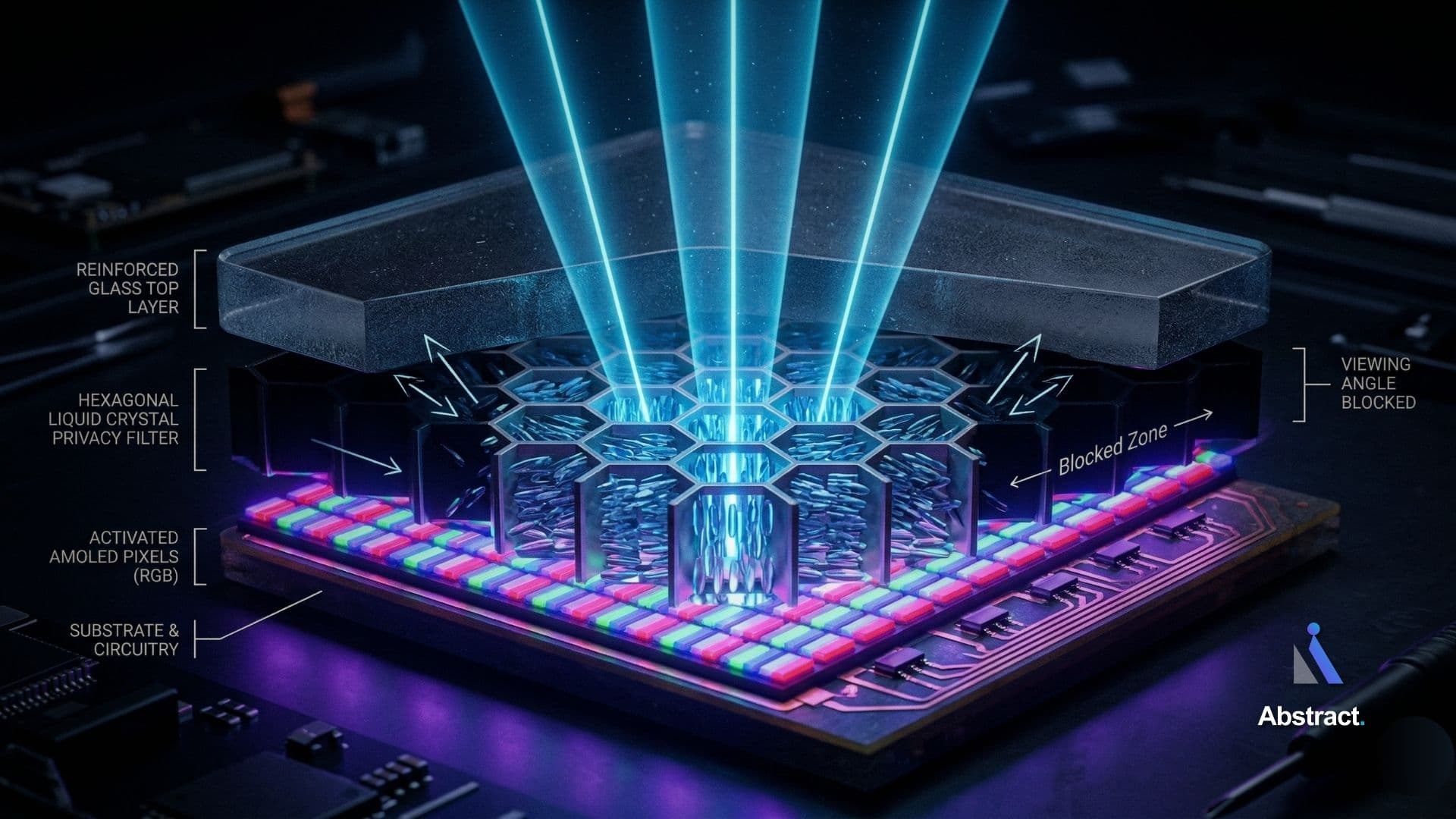
The S26 screen's foundation is the new generation Dynamic AMOLED 6X. However, the secret to privacy lies in an additional layer called LC-APF (Liquid Crystal Active Privacy Filter).
How does it physically work?
Unlike a common panel, the S26 integrates a layer of ultra-responsive liquid crystals positioned between the emitter substrate and the Gorilla Armor glass.
Public Mode: The liquid crystals are aligned to allow light to spread at a wide viewing angle (up to 178°), letting you show a video to a friend next to you.
Private Mode: When activated, a specific electrical current alters the orientation of these crystals, creating what we call Electronic Micro-Louvers. They act like microscopic blinds that block the lateral dispersion of light.
The result? From an angle of 30 degrees, the screen appears completely off or displays a diffraction pattern that makes the content unreadable, while for you, positioned head-on, brightness and color accuracy remain intact.
2. The Software: The "Neural Shield" and Eye Tracking
Hardware provides the physical blocking, but software makes the experience intelligent. The S26 uses the new Exynos 2600 (or Snapdragon 8 Gen 5) processor to run what Samsung calls AI Vision Shield.
Real-Time Eye Tracking
The front camera and the Proximity-TOF (Time of Flight) sensor constantly monitor the field of view in front of the device.
Intruder Detection: If the AI detects a second pair of eyes focused on the screen (the famous "shoulder surfing"), the system sends a subtle notification or automatically increases the intensity of the privacy filter.
Dynamic Gamma Correction: One of the biggest problems with privacy screens is contrast loss. The S26 software compensates for this in real-time, adjusting gamma curves so that, even with the active filter, your content's shadows and highlights remain sharp for you.
3. The Engineering Challenge: 120Hz and 3500 nits Brightness
Samsung's greatest triumph in 2026 was implementing this technology without sacrificing top-tier specifications. Historically, privacy filters reduce maximum brightness by up to 30%.
To overcome this, Samsung engineers developed the Dual-Emissive Subpixel. Instead of just blocking light, the panel redirects luminous energy that would be wasted on the sides back to the center of the viewing angle. This not only maintains visibility under intense sunlight but also improves energy efficiency by up to 15% when privacy mode is activated.
4. Integration with the Knox Ecosystem
Screen privacy isn't just aesthetic; it's integrated with Samsung Knox. Companies can configure policies where "Private Mode" is mandatorily activated whenever a work application (like Outlook or Microsoft Teams) is opened, or when GPS detects the user is in a public place like an airport.
5. Why This Matters for the Pro Market?
Here at Abstract, we deal with founders and developers who carry trade secrets and proprietary code on their devices. The S26's technology solves a human vulnerability that no firewall can prevent: physical sight.
We are moving out of the era where security is just about bits and bytes, and into the era of Active Contextual Security. Hardware is no longer passive; it understands where you are and who is around you.

Written by
Vinicius Silva
Vinicius Silva é fundador da Abstract Prisma e criador do AbstractOS, o sistema operacional digital que reúne criação de software com IA, gestão de negócios e marketing num lugar só, pensado para PMEs e fundadores no Brasil. Escreve sobre operação de negócios, criação de produtos com IA, marketing e o ecossistema digital brasileiro (Pix, NF-e, WhatsApp, LGPD).
Published on Nov 5, 2026
Was this article helpful to you?
Precisa de um produto digital sob medida?
Somos a agência por trás do AbstractOS. Full-stack, design e IA — do MVP ao scale-up.
Related modules
Put what you just read into practice with these platform modules.
Comments
Be the first to comment.